Regenerative Medicine
Double Chin: Causes and Non-Surgical Solutions
The double chin is one of the aesthetic concerns that most frequently brings people to seek consultation at our Milano and St. Moritz locations, almost always with the same phrase: I've tried to lose weight, but nothing changes here.
This is an accurate observation, and explains why the problem deserves a dedicated assessment rather than a generic remedy. At IMAGE REGENERATIVE we work on this area with protocols calibrated to the predominant cause, combining lipolytic technologies, toning treatments and, in selected cases, surgery.
The comparison between cryolipolysis and liposuction is the most useful starting point for understanding what a non-surgical approach can truly achieve.
What is a double chin (or submental fullness) and why does it form
Double chin, or submental fullness, refers to the accumulation of tissue in the submental region, the space between the chin and the neck. The visible result is an additional fold under the jawline and a profile that appears heavier, with the loss of that sharp line separating the face from the neck.
Three different components contribute to its formation, and their proportion determines which treatment makes sense:
- Submental fat, a localized deposit that responds poorly to diet.
- Skin laxity, the reduction in tone and elasticity that accompanies aging.
- Platysma sagging, the thin muscle covering the neck that tends to relax over time.
Understanding which component predominates is the most important part of the consultation. Adipose accumulation in still-toned skin is addressed differently from a profile that has softened primarily due to laxity, even when the external appearance seems similar.
Causes of double chin: weight, genetics, age and posture
Weight is the most intuitive cause but far from the only one. Weight gain promotes fat deposition in this region as well, but many normal-weight people live with a prominent double chin, and this depends on the other factors at play.
Genetics weighs considerably: there is a familial predisposition to accumulate fat in the submental area, and this same predisposition explains why the area resists general weight loss. Those with this characteristic lose inches elsewhere before losing them on the chin.
Age acts on a different plane. Over time collagen and elastin decrease, skin loses compactness and the platysma relaxes: the profile sags even in the absence of excess fat. This is why, after a certain age, lipolytic treatments alone may prove insufficient.
Posture plays an often underestimated role. The many hours spent with the head bent forward, in front of a screen or phone, chronically shorten the anterior neck region and accentuate the submental fold.
Finally, bone structure must be considered. When the chin is poorly projected, due to conformation or discrepancy between dental arches, the profile appears heavy even with very little adipose tissue. In these cases the problem is one of skeletal proportions and the correct response comes from an assessment of the structure, not from treatment of the fat.
How to eliminate double chin without surgery

Aesthetic medicine today offers tools capable of intervening on this area without an operating room, with the realistic premise that they act progressively and on precise targets.
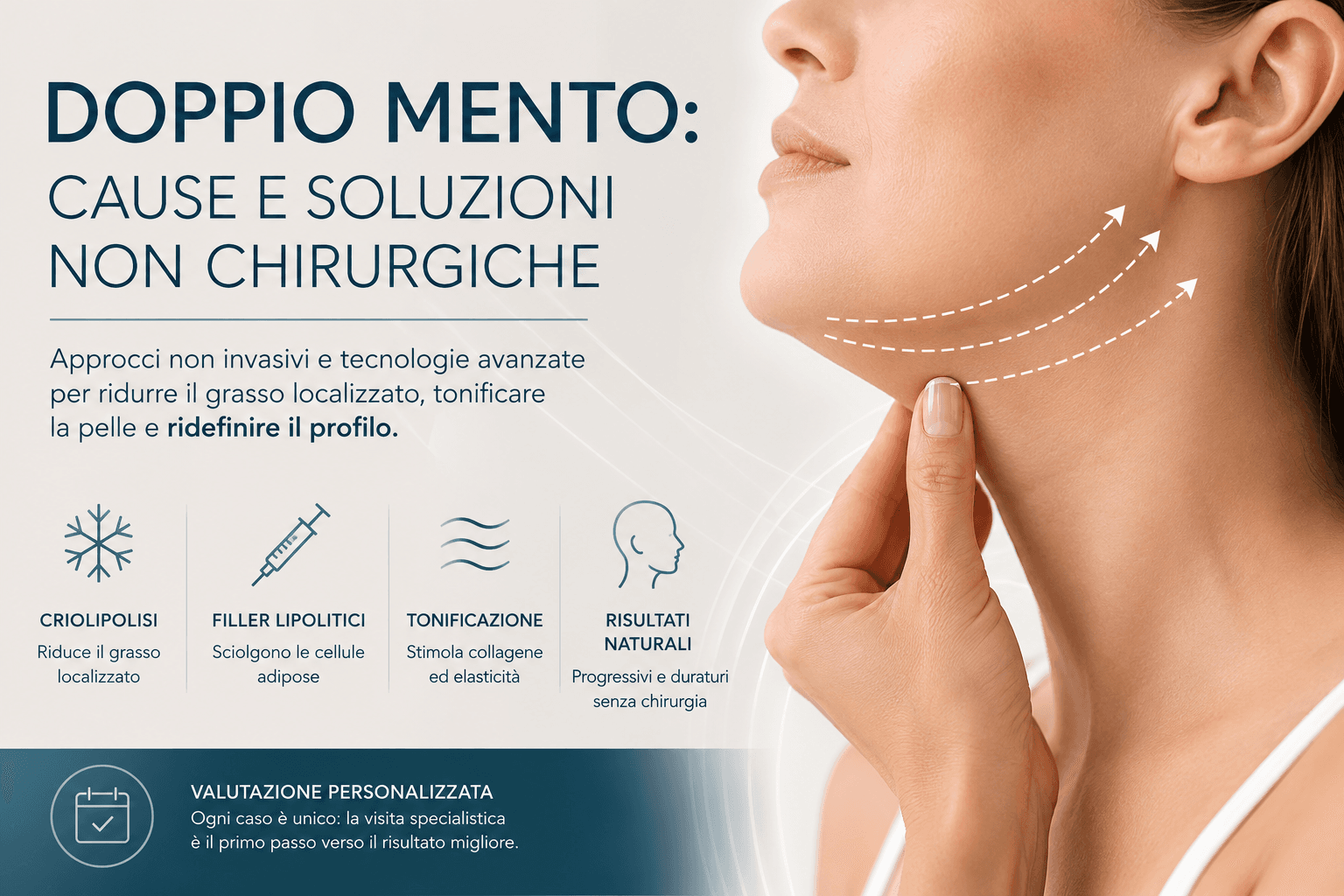
The selection logic follows the predominant component. If the problem is adipose, we work on fat cells, with controlled cold or with injectable lipolytic substances. If the problem is tone, we stimulate collagen and elastin with technologies that heat the dermis deeply. In most real cases the two components coexist, and the protocol combines both directions in sequence.
Another element to take into account is time. These technologies act through biological processes, so the result is observed over weeks and not at the end of the session. Those expecting an immediate change will be disappointed by a process that is actually working: in our practice, explaining the time curve in advance is part of the treatment, because it allows evaluation of the result at the right moment and decision-making with real data on whether to continue.
It must be stated with equal clarity what a non-surgical approach can achieve and what remains beyond its reach. Faced with significant skin excess, marked platysmal bands or unfavorable bone structure, the technologies can improve the appearance of the area, while true reshaping of the jawline requires other tools. Stating this during consultation avoids long and disappointing paths.
Non-surgical treatments: cryolipolysis and lipolytic injections
Cryolipolysis, in the CoolSculpting version, uses controlled cooling between eleven and thirteen degrees below zero. At that temperature fat cells lose viability and are removed by the body physiologically in the following weeks, without damage to skin, nerves and muscles. The session lasts between thirty and sixty minutes per area, requires no anesthesia or incisions and allows immediate resumption of daily activities. Sessions are spaced six to eight weeks apart, because the result builds gradually.
Intralipotherapy acts with a different logic. Through micro-injections, biocompatible lipolytic solutions are introduced, such as deoxycholic acid and phosphatidylcholine, which fragment the adipose tissue; the dissolved material is then drained through the lymphatic system. Here too the session takes between thirty and sixty minutes and the cycle involves sessions four to six weeks apart.
On the toning side, Coolwaves work, selective microwaves that act simultaneously on fat cells, connective tissue and skin. Controlled heating stimulates collagen and elastin production while a cooling system protects the skin surface. Each area requires fifteen to twenty minutes and the protocol involves four to six sessions two to three weeks apart.
Treatment | What it acts on | Session duration | Cycle rhythm |
CoolSculpting Cryolipolysis | Fat cells, with controlled cooling | 30-60 minutes per area | Sessions 6-8 weeks apart |
Intralipotherapy | Fat cells, with injectable lipolytic solutions | 30-60 minutes | Sessions 4-6 weeks apart |
Coolwaves | Fat, connective tissue and skin tone, with selective microwaves | 15-20 minutes per area | 4-6 sessions 2-3 weeks apart |
Suitability must always be verified by a physician: some clinical conditions advise against these procedures, and significant adipose volumes have different indications.
Exercises and remedies to reduce double chin
Targeted exercises for the neck and platysma have a role, provided it is placed in the right perspective. Muscular work improves the tone of the anterior cervical musculature and supports the submental region, but acts on the muscle and leaves the overlying fat deposit substantially unchanged. No facial exercise, however consistent, produces selective fat reduction in a circumscribed area.
What truly matters, and what we always recommend as a foundation, concerns daily habits. Postural correction is the first intervention: maintaining the screen at eye level and recovering neck extension reduces the mechanical accentuation of the fold. Regular aerobic activity, combined with balanced nutrition, acts on overall fat mass and also improves this area in overweight people. Finally, pay attention to sodium and hydration, because fluid retention accentuates regional swelling transiently but visibly.
A useful clarification concerns home remedies circulating online. Creams, patches and devices that promise to reshape the profile act at most on superficial skin hydration and momentary swelling, without reaching deep adipose tissue or the muscular plane. Considering them for what they are, that is daily care gestures, avoids postponing an assessment that could direct toward truly effective solutions.
In our team's experience, these remedies make the result obtained with medical treatments more stable over time, while alone they rarely modify a structured double chin.
Neck lift: when surgery is needed
When the predominant component is tissue laxity and not fat, the path changes. In the presence of skin excess, evident platysmal bands or a clear loss of the jawline, non-invasive technologies improve skin quality without repositioning what has descended. In these cases the indication becomes surgical.
The mini-lift intervenes on the lower third of the face, therefore on jawline, cheeks and chin, with reduced invasiveness compared to the complete lift, and is indicated for moderate laxity. The partial lift instead focuses on a single area, the neck for example, when the rest of the face does not require correction. When the profile depends primarily on poor chin projection, the assessment also considers mentoplasty, because in that case acting on fat would bring marginal benefit.
Here comes into play the regenerative approach that characterizes our work. In regenerative lifting, surgical tissue repositioning is associated with autologous adipose tissue grafting treated with Lipogems® technology: the mesenchymal cells contained in the patient's fat have anti-inflammatory and regenerative properties, promote faster healing and improve skin quality, beyond its position. Recovery follows defined timelines: swelling and bruising begin to reduce within the first week and continue to improve over the following two to three weeks.
The difference compared to traditional lifting lies in this step. Repositioning tissues corrects neck geometry, while regenerative grafting also intervenes on the quality of repositioned tissues, which is the variable on which the result's durability over time depends.
Frequently asked questions
Do exercises for double chin really work?
They improve the tone of neck musculature and support the submental region, so they have a supportive role. However, they do not selectively reduce localized fat, because targeted weight loss of a single area is not physiologically possible. They remain useful as a habit associated with medical treatments and postural correction, rather than as a sole remedy.
Can you have a double chin even when thin?
Yes, and it is a frequent situation. Genetic predisposition to accumulate fat in the submental region, age-related skin laxity, platysma relaxation and poor chin projection produce a heavy profile even in normal-weight people. This is why general weight loss alone often leaves the area unchanged.
How many cryolipolysis sessions are needed for double chin?
The number depends on the amount of adipose tissue and the objective, and is defined by the physician after assessment. Each session lasts between thirty and sixty minutes per area and sessions are spaced six to eight weeks apart, because removal of treated cells occurs physiologically and progressively in the following weeks.
When is it necessary to move to surgery?
When the predominant component is skin excess or platysma sagging, and not fat. In the presence of marked platysmal bands, significant laxity or an already undefined jawline, non-invasive treatments improve skin quality without repositioning descended tissues. In those cases mini-lift or partial neck lift offer an adequate response.
Related Articles
 regenerative-medicine
Intravenous NAD+ Therapy: What It Is and What It's For
Intravenous NAD+ therapy: what it is, what it's for, and the benefits for energy and anti-aging. How the session works, differences with supplements, and side effects.
 regenerative-medicine
Deflated Breasts After Breastfeeding: Causes and Solutions
Deflated breasts after breastfeeding: causes and solutions, from exercises to firm the breasts to medical solutions like mastopexy and lipofilling. Complete guide.
 regenerative-medicine
Longevity, Anti-Aging and Biohacking: What They Really Mean
Longevity, anti-aging and biohacking: what they really mean and how they differ, between longevity medicine and optimization of body and mind.
Want More Info?
If you need more information, call us at +39 02 76280736, message us on WhatsApp, email us at info.milano@imageregenerative.com, or use the form below.