Regenerative Medicine
Oxygen Ozone Therapy: What Is It? What Are the Benefits?
Persistent back pain and herniated discs are the two most common reasons people seek ozone therapy. However, expectations surrounding this treatment vary widely, some founded and others less so.
At IMAGE REGENERATIVE, in Milano and St. Moritz, oxygen ozone therapy is used both in chronic pain management and within longevity pathways.
Let's explore what the oxygen-ozone mixture really is, which conditions it makes sense to use it for, how a session unfolds, what it costs, and in which situations it's best avoided.
What is oxygen ozone therapy
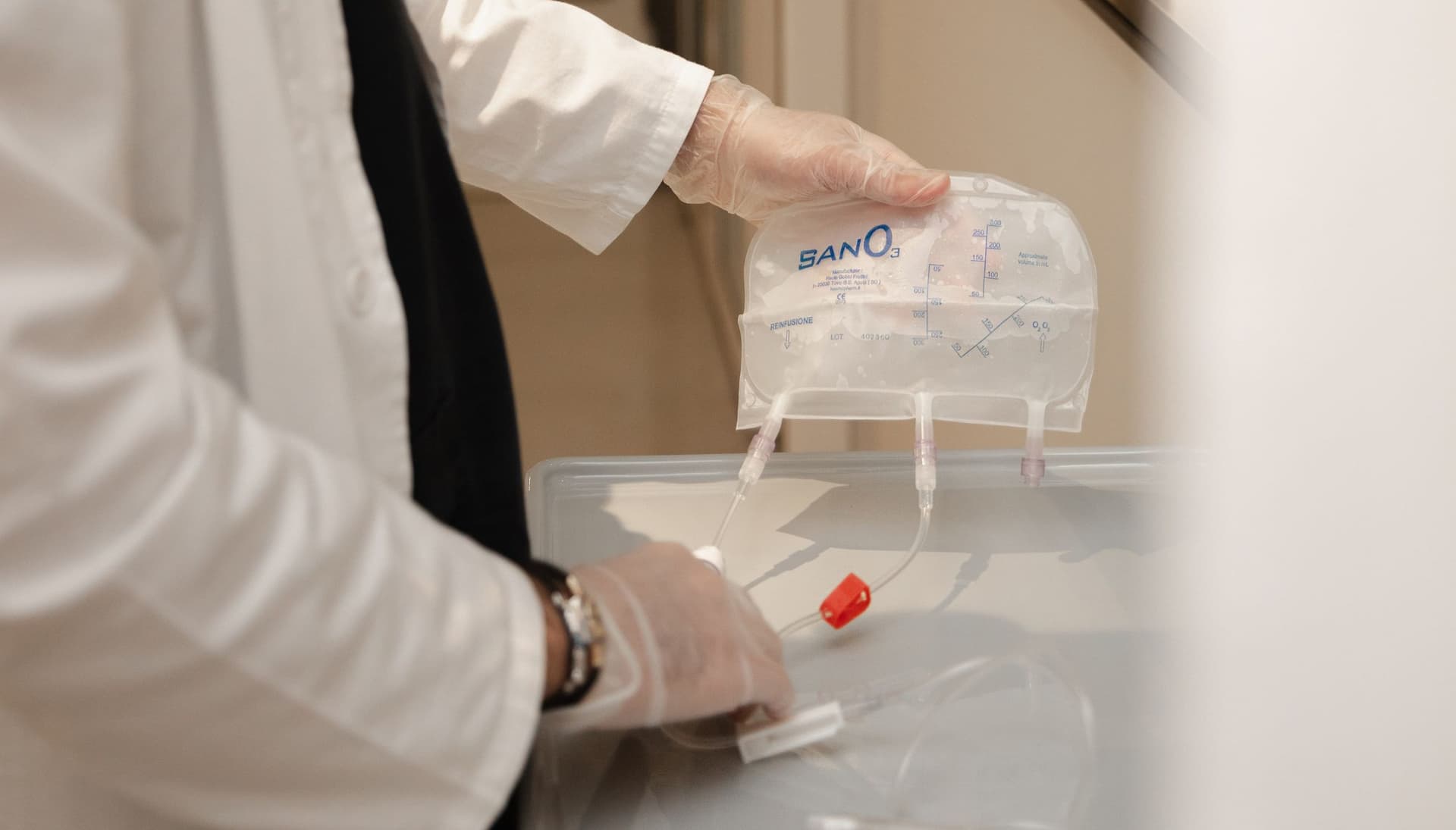
Oxygen ozone therapy uses a gaseous mixture of medical oxygen and ozone, produced on-site by a generator and administered in low, measured concentrations. Ozone is an unstable molecule composed of three oxygen atoms, and this very instability underlies its biological effect, as releasing one atom triggers a controlled reaction in the tissues it contacts.
The mechanism of action can be summarized in three main effects. The first concerns the modulation of oxidative stress, as mild, repeated stimulation activates the body's endogenous antioxidant systems. The second is the action on microcirculation, since ozone increases red blood cell deformability and improves oxygen delivery to peripheral tissues. The third is the local anti-inflammatory effect, with a reduction in mediators that sustain chronic pain.
A clarification about concentration avoids many misunderstandings. Atmospheric ozone, the kind in summer air quality alerts, is inhaled and irritates the airways, whereas in medical settings the mixture is administered via infiltration, intra-articular, or blood routes at defined doses and never by inhalation. These are two situations that share only the name of the molecule.
It should be added that medical ozone is prepared on the spot and used immediately, because the molecule decays quickly and cannot be stored. This explains the presence of a generator in the clinic and makes the quality of the equipment, along with concentration calibration, a technical element far from secondary.
What it's for: the benefits of ozone therapy
The areas where this therapy is proposed are diverse, and it's worth distinguishing those with more solid literature from supportive ones. The benefits observed most consistently in clinical practice concern specific areas:
- Pain of vertebral and joint origin, where the local anti-inflammatory action reduces the inflammatory component that feeds the symptom.
- Microcirculation disorders in the lower limbs, with an effect on heavy legs, swelling, and tissue retention.
- Cellulite understood as edematous-fibro-sclerotic panniculopathy, where ozone acts on interstitial fluid stagnation.
- Recovery after intense exertion or sports trauma, as support during the rehabilitation phase.
- General support in conditions characterized by low-grade systemic inflammation, within broader pathways.
In our team's experience, the best response is obtained for musculoskeletal pain with an active inflammatory component. When the condition is predominantly mechanical or advanced degenerative, the benefit is more limited and should be stated before starting a cycle, because wrong expectations are the main cause of dissatisfaction.
Applications: herniated disc, back and joints
The most studied application concerns lumbar disc herniation. The rationale is twofold, as ozone exerts an anti-inflammatory action on the structures surrounding the compressed nerve root and, when injected into the disc, contributes to reducing the volume of the herniated nucleus pulposus through a dehydration process of the disc material.
The available evidence for this indication is relatively consistent. A meta-analysis published in 2024 in the Journal of Back and Musculoskeletal Rehabilitation compared intradiscal ozone injections with other options in the treatment of lumbar herniation pain, finding at six months and beyond a therapeutic effect superior to steroid infiltrations and oral medications, and substantially similar to microdiscectomy in the eighteen-month evaluation. The authors conclude that it is a useful tool, while noting the heterogeneity of the included studies.
Besides the spine, the most frequent musculoskeletal applications concern joints. Intra-articular infiltration is used in early and intermediate knee and hip osteoarthritis, where it often accompanies other treatments, while the paravertebral route is the usual choice for chronic low back pain and neck pain with a muscular component. It should be said that in advanced osteoarthritis, with exhausted joint space, therapy can attenuate pain without modifying structure, and in those cases the discussion shifts to other options.
How a session unfolds
The session begins with a medical evaluation that establishes the route of administration, concentration, and expected number of applications. Duration varies greatly depending on the chosen technique, from about fifteen minutes for a local infiltration to approximately one hour for blood treatments.
Route of administration | Main indication | Indicative duration |
Paravertebral infiltration | Chronic low back and neck pain | 15-20 minutes |
Intra-articular infiltration | Knee, hip and shoulder osteoarthritis | 15-20 minutes |
Intradiscal injection | Lumbar disc herniation, in dedicated facility | 30-45 minutes |
Major autohemotherapy | Systemic conditions, microcirculation, general support | 45-60 minutes |
Rectal insufflation | Inflammatory intestinal disorders, systemic effect | 15-20 minutes |
Mesotherapy with ozone | Cellulite, localized fat deposits, scalp | 20-30 minutes |
The typical cycle involves ten to twenty sessions, with weekly or biweekly frequency depending on the indication and observed response. In acute musculoskeletal conditions, cycles are shorter and more frequent, while in systemic support pathways, sessions are distributed over a longer period.
After the session, you return to normal activities without particular restrictions, with the indication to avoid intense exertion in the hours immediately following when treatment has involved the spine or a joint. In major autohemotherapy, brief observation is provided at the end.
Does ozone therapy hurt? Safety and effects
The question comes up often and deserves an answer on two distinct levels: perceived pain and safety.
Regarding pain, the sensation depends on the technique. Subcutaneous and paravertebral infiltrations involve modest discomfort, comparable to that of a normal injection, with a sensation of swelling or crackling due to the presence of gas in the tissues, which is reabsorbed within minutes. Intra-articular and intradiscal procedures are performed with local anesthesia and, in the case of the disc, under radiological guidance.
Regarding the safety profile, the therapy is generally well tolerated when performed by trained personnel with correct concentrations. The most common adverse effects are local and transient: a sense of tension in the treated area, mild burning during injection, and occasionally a brief sense of fatigue in the following hours. Serious complications are rare and almost always attributable to technical or dosage errors, which is why operator training and equipment quality matter much more than the chosen protocol.
A useful indicator for those evaluating where to be treated concerns precisely this aspect. A serious center declares the concentration used, explains why it has chosen a certain route of administration, and schedules an interim cycle review, instead of proposing an identical package of sessions for all patients and any disorder.
How much does it cost and is it covered
The cost depends on the route of administration, cycle duration, and context in which the procedure is performed. A paravertebral infiltration has a different financial commitment than major autohemotherapy or an intradiscal injection performed under radiological guidance, and since therapy is structured in cycles, the useful reference is the overall cost of the pathway rather than that of the single session. Updated rates can be consulted in the clinic's price list.
Regarding coverage, the answer requires precision. Oxygen ozone therapy is not included among the services in essential levels of assistance, so in most cases the cost remains the responsibility of the individual. Some hospital facilities offer it within specific pathways with arrangements that vary from center to center, so information should be verified directly with the reference facility rather than taken for granted.
A final aspect concerns private health insurance, which in some policies provides reimbursement when therapy is prescribed for rehabilitative or pain management purposes. It's advisable to request written confirmation from the company before starting the cycle, because conditions vary significantly from one contract to another.
Contraindications and for whom it is indicated
The therapy is indicated for adults with musculoskeletal pain of inflammatory nature, microcirculation disorders, or conditions that benefit from systemic anti-inflammatory support, always after a medical evaluation that frames the cause of the symptom.
However, there are conditions in which treatment should be excluded or postponed. The main ones are as follows.
- Favism, i.e. glucose-6-phosphate dehydrogenase deficiency, in which induced oxidation can cause hemolysis.
- Pregnancy and breastfeeding, periods for which sufficient safety data are lacking.
- Uncontrolled hyperthyroidism, due to the risk of accentuating already elevated metabolic activity.
- Unstabilized epilepsy and active coagulation disorders, which require dedicated specialist evaluation.
To these are added situations to be evaluated case by case, such as significant anemias, ongoing anticoagulant therapies, and acute infections, which normally postpone the cycle to a later time. The intake visit serves precisely to verify these aspects and to determine whether therapy is the right answer to the problem, or whether it's better to pursue another path.
Frequently asked questions
How many ozone therapy sessions are needed?
The standard cycle ranges from ten to twenty sessions, with weekly or biweekly frequency. In acute musculoskeletal conditions, shorter and more frequent cycles are used, while in systemic support pathways, sessions are distributed over a longer period. The number is reviewed based on the response observed in the first applications.
Does ozone therapy hurt during the session?
Subcutaneous and paravertebral infiltrations cause discomfort similar to that of a common injection, accompanied by a sensation of swelling due to gas that is reabsorbed within minutes. Intra-articular and intradiscal procedures are performed with local anesthesia, and in the case of the disc under radiological guidance.
Is ozone therapy covered?
It is not included among the services in essential levels of assistance, so normally the cost is borne by the individual. Some facilities offer it within specific pathways with varying arrangements, and some private health policies provide reimbursement when the prescription is for pain management or rehabilitative purposes. It's advisable to verify in advance.
Can ozone therapy be done during pregnancy?
No. Pregnancy and breastfeeding are among the conditions in which treatment is excluded, due to absence of sufficient safety data. During these periods, musculoskeletal pain management follows different paths, to be agreed upon with the gynecologist and with the specialist following the disorder.
Content reviewed by the medical-scientific committee of IMAGE REGENERATIVE. The information provided is for informational purposes and does not replace specialist consultation.
Related Articles
 regenerative-medicine
Décolleté Rejuvenation: How to Care for Neck and Chest
Décolleté rejuvenation: how to care for neck and chest, from neck wrinkles to Venus rings. Treatments, fillers and biostimulation for the skin.
 regenerative-medicine
 regenerative-medicine
Regenerative medicine: repair, regenerate or prevent?
Regenerative medicine: repair, regenerate or prevent? How stem cells, PRP and autologous therapies work, their applications and what the evidence shows.
Want More Info?
If you need more information, call us at +39 02 76280736, message us on WhatsApp, email us at info.milano@imageregenerative.com, or use the form below.