Regenerative Medicine
Rhinoplasty or Nose Filler: Differences, Duration, and Results
At IMAGE REGENERATIVE, we receive this question almost every week, both in Milano and St. Moritz: to improve the nose profile, should I choose nose filler or rhinoplasty?
The honest answer is that these two procedures do not represent the light version and the intensive version of the same thing.
They are different tools with opposite approaches: one adds volume with a resorbable material, the other permanently modifies bone and cartilage. In regenerative facial aesthetic surgery, the choice always starts with the person's goal, never with the available technique.
Understanding this distinction is the first step to navigating without expecting from an injection what only surgery can deliver.
Rhinoplasty and Nose Filler: The Main Differences

The fundamental distinction is clear and worth establishing immediately, because everything else follows from it.
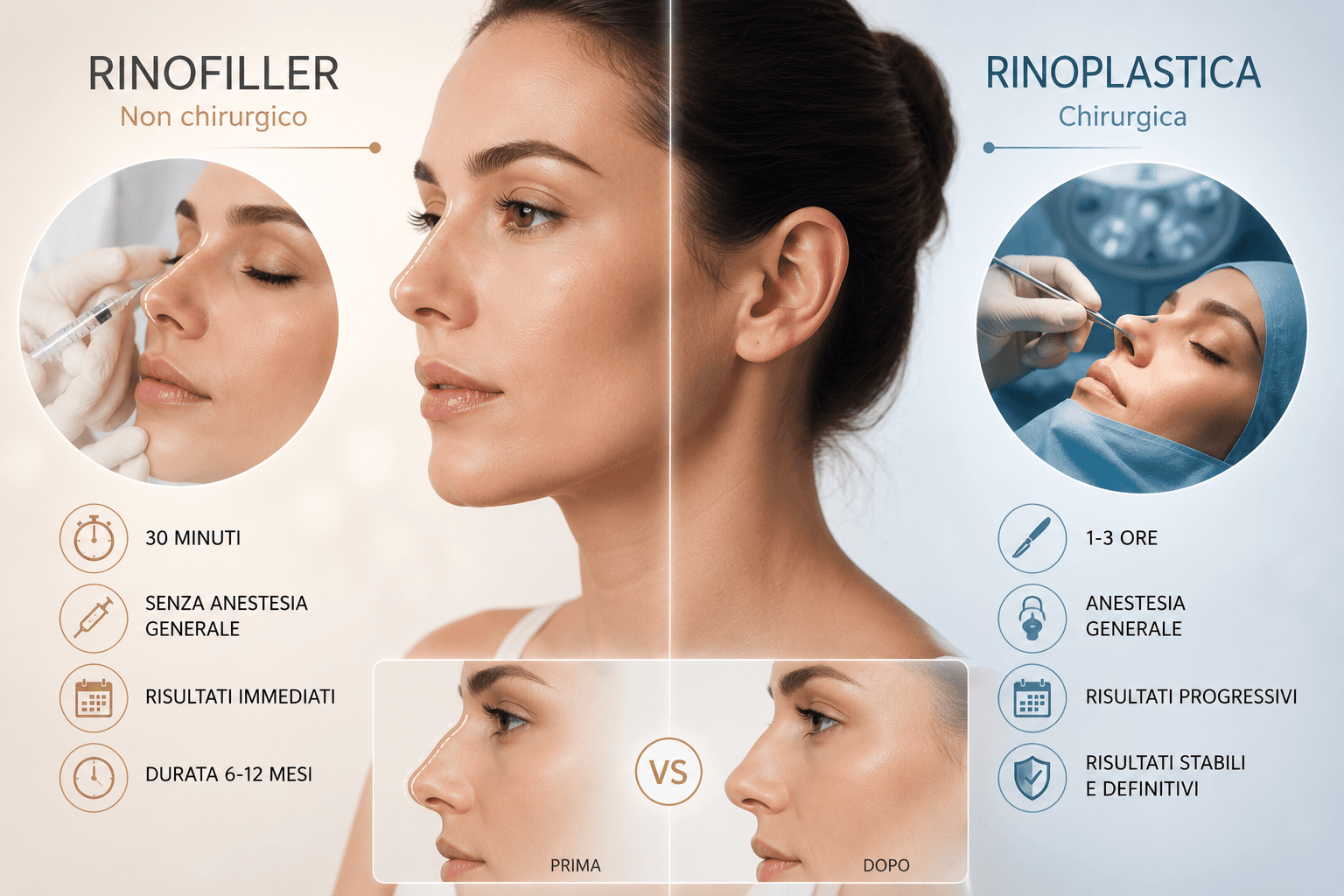
Nose filler, also called non-surgical rhinoplasty, belongs to aesthetic medicine. Very small quantities of filler, typically hyaluronic acid, are injected into precise points on the bridge or tip to specifically correct certain profile irregularities. The material is resorbable and the approach is additive: it can only add volume where needed.
Rhinoplasty is instead an aesthetic surgery procedure. It reshapes the bone and cartilage structures, so it can reduce, remodel, and correct the nose's structure. When the surgeon also operates on the nasal septum, it is called septorhinoplasty, a procedure that combines aesthetic and functional purposes.
Put simply: nose filler harmonizes a profile by adding volume, rhinoplasty corrects its structure. They are complementary rather than alternative procedures, and the useful question during consultation is not which is better, but which is suitable for that nose and that goal.
What is Nose Filler and How Does It Work
Nose filler is an outpatient procedure lasting approximately thirty minutes. Using a fine needle or cannula, hyaluronic acid is deposited in selected points of the nose, after applying an anesthetic cream. Certified, dense, and structured products are used, because the result's durability depends on the material's rheology as well as the injector's skill.
In our team's experience, the most frequent request concerns reducing a mild hump, the so-called bump: by precisely filling the area above and below the prominence, the profile appears more linear. Nose filler is also used to correct minimal bridge asymmetries, to provide slight support to the tip in selected cases, and to refine small residual irregularities after surgical intervention.
Here lies the technique's logical limit, which must be stated clearly. Since filler only adds volume, a nose perceived as large does not become smaller after treatment: the profile is harmonized, overall proportions remain the same. Those seeking size reduction need a different tool, and proposing filler means postponing the problem.
What is Rhinoplasty: The Surgical Procedure

Rhinoplasty permanently reshapes nasal structures. At IMAGE REGENERATIVE, it is performed by specialists with dual training in plastic surgery and maxillofacial surgery, a combination that allows reading the nose together with the rest of the face's architecture and intervening on aesthetic, functional, and structural planes in the same session.
The procedure is performed under general anesthesia and typically lasts from one to three hours, depending on case complexity. The techniques employed aim to preserve nasal functionality and contain post-operative swelling. Most patients resume normal activities within one to two weeks, while the final result settles over several months as edema reduces and tissues stabilize.
Compared to an injection, surgery allows operations that filler cannot perform: reducing a bony or cartilaginous hump instead of masking it, reshaping the tip, correcting structural deviations, and addressing breathing when compromised by a deviated septum or turbinate hypertrophy. As Prof. Carlo Tremolada, the clinic's scientific director, notes, for a complete evaluation it is useful to come to the first consultation already with a CT scan of the nasal pyramid and cavities.
How Long Does Nose Filler Last and When Rhinoplasty Is Needed
This is where the choice becomes concrete, because the two procedures have opposite time horizons.
Nose filler is temporary. Hyaluronic acid is progressively resorbed and the effect lasts on average between six and twelve months, with variability related to individual metabolism, the product used, the treated area, and the quantity. With repeated sessions, the result tends to stabilize and in many cases minimal touch-ups every twelve to eighteen months suffice. The precise estimate must however be made for the individual case during consultation, never taken as a fixed value.
Rhinoplasty provides a stable result over time: once settling is complete, it does not require periodic maintenance sessions.
From this derive mirror practical indications. Nose filler makes sense when the defect is small and additive in type, when one desires to observe a profile improvement before deciding whether to face the operating room, or when one prefers an outpatient procedure accepting its temporariness. Rhinoplasty is the indicated route when size or volume reduction is needed, when the problem is structural or respiratory, and when a result that maintains itself without renewals is desired.
Results Compared: Before and After
Caution is needed on the topic of before and after. In healthcare, comparison images must be handled carefully, because every nose, every skin, and every healing capacity responds differently, and no outcome is reproducible identically from one person to another. Rather than promising a result, it is useful to clarify what type of change each procedure can realistically produce.
Criterion | Nose Filler | Rhinoplasty |
Type of procedure | Injectable, outpatient | Surgical |
Anesthesia | Topical or local | General |
Session duration | About 30 minutes | From 1 to 3 hours |
What it can do | Add volume and harmonize the profile | Reduce and reshape bone and cartilage |
Reduces nose size | No | Yes |
Acts on breathing | No | Yes, with septorhinoplasty |
Result duration | From 6 to 12 months, with touch-ups every 12 or 18 months | Stable, with settling over several months |
Activity resumption | Immediate | From 1 to 2 weeks |
Reversibility | Product can be dissolved in medical setting | Not planned |
Recommended age | From adolescence | From 16 years |
The table makes the key point evident: the comparison is not a competition. If the goal is to harmonize with a reversible intervention, filler is adequate; if the goal requires removing tissue or correcting breathing, filler cannot achieve it, no matter how well executed.
Risks and Negative Experiences with Nose Filler
Nose filler is often presented as harmless because it is not surgery. This is a simplification that deserves clear correction. The nose is one of the most delicate areas of the face for fillers, due to its vascularization: beneath the skin run vessels connected to ocular circulation. Therefore the procedure requires thorough knowledge of facial anatomy and should not be trivialized.
The complications that our aesthetic medicine team considers with utmost attention are of four types:
- Vascular occlusion, the most feared: if the product compresses or enters a vessel, blood flow can be interrupted, with consequences ranging from skin suffering to, in rare but documented cases in literature, vision impairment. It is an emergency requiring immediate recognition and management.
- Tyndall effect, which manifests when hyaluronic acid is positioned too superficially and gives the skin a bluish reflection.
- Swelling, bruising, and small irregularities to touch, generally transient, but sometimes requiring correction.
- Migration or accumulation of product over time, which can weigh down the profile compared to the initial result.
One point must be clarified because it generates false security: the material's reversibility does not nullify the procedure's risks. Hyaluronic acid can be dissolved with an enzyme, hyaluronidase, and it is a valuable resource in medical hands, allowing correction of an unsatisfactory result or intervention in the face of a problem. However, dissolving filler acts on the cause and does not automatically repair damage already occurred, such as vascular suffering. Real safety lies upstream: anatomical evaluation, correct technique, and a facility capable of recognizing and managing a complication.
How to Choose Between Nose Filler and Rhinoplasty
There is no answer valid for everyone, and distrusting those who propose one is already a good criterion. As a practical guide, the reasoning is articulated in four steps.
The first is to start from the goal rather than the procedure. If one desires to reduce or remodel, meaning to intervene on a nose perceived as large, on a significant hump, on a tip to correct, or on a breathing difficulty, the domain is surgical. If one desires to harmonize a small additive irregularity, nose filler may be adequate.
The second step concerns the time horizon: accepting periodic maintenance or preferring a setting that stabilizes once and for all radically changes the choice.
The third consists of considering filler also as a reversible verification: in selected cases, observing a modified profile helps decide with greater awareness whether to face surgery.
The fourth is to avoid choosing based solely on perceived invasiveness. A filler performed with the wrong goal does not spare an intervention, it simply does not solve the problem for which it was requested.
The correct way to orient oneself remains the specialist consultation. Only a direct evaluation of the nose, skin quality, and expectations allows indicating the suitable route, or establishing whether the two can be integrated into a pathway. At our Milano and St. Moritz locations, the discussion occurs with a team that includes both aesthetic medicine and aesthetic surgery, so as to propose the truly indicated option.
Frequently Asked Questions
Can Nose Filler Replace Rhinoplasty?
No. Nose filler adds volume to harmonize the profile, while it does not reduce nose size and does not correct structure or breathing. It can mask certain irregularities and, in selected cases, function as a reversible verification before a surgical decision. They remain complementary tools with different indications.
How Long Does Nose Filler Last?
The effect lasts on average between six and twelve months, because hyaluronic acid is progressively resorbed. With repeated sessions, the result tends to stabilize and often minimal touch-ups every twelve to eighteen months suffice. Duration depends on individual metabolism, product, area, and quantity, so it must be estimated during consultation.
If Filler Is Reversible, Does That Mean It's Risk-Free?
No. Hyaluronidase allows dissolving the product and correcting an unwanted result, but it acts on the cause and does not by itself repair damage already occurred, such as vascular suffering. The nose is a richly vascularized area: safety depends on prevention, meaning anatomical evaluation, technique, and complication management.
Does Rhinoplasty Also Improve Breathing?
It can when the procedure includes correction of the nasal septum or turbinates, and in that case it is called septorhinoplasty. The goal becomes both aesthetic and functional. Nose filler, on the contrary, has no effect on breathing and is not indicated when a structural problem exists.
Related Articles
 regenerative-medicine
Intravenous NAD+ Therapy: What It Is and What It's For
Intravenous NAD+ therapy: what it is, what it's for, and the benefits for energy and anti-aging. How the session works, differences with supplements, and side effects.
 regenerative-medicine
Deflated Breasts After Breastfeeding: Causes and Solutions
Deflated breasts after breastfeeding: causes and solutions, from exercises to firm the breasts to medical solutions like mastopexy and lipofilling. Complete guide.
 regenerative-medicine
Longevity, Anti-Aging and Biohacking: What They Really Mean
Longevity, anti-aging and biohacking: what they really mean and how they differ, between longevity medicine and optimization of body and mind.
Want More Info?
If you need more information, call us at +39 02 76280736, message us on WhatsApp, email us at info.milano@imageregenerative.com, or use the form below.